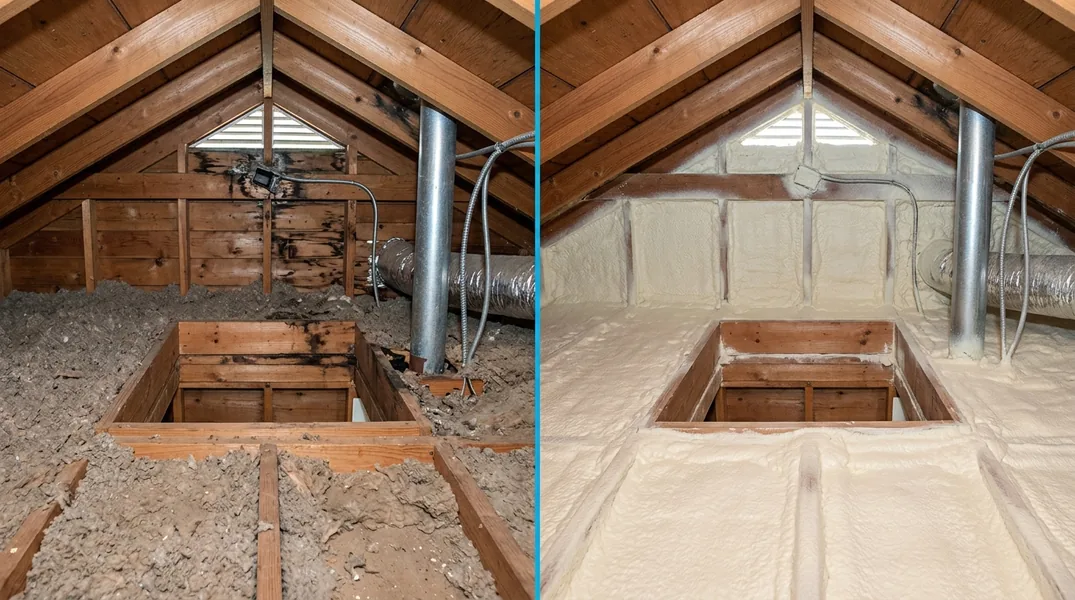
The Greensboro Climate Challenge: Why Insulation Matters
If you own a home in Greensboro, you know that our North Carolina summers bring humidity and heat, while winters demand reliable temperature control. Your attic is ground zero for energy loss. Hot air rises, and in winter, that means your heating dollars literally escape through an inadequately insulated roof. In summer, radiant heat from the sun beats down on your shingles and radiates into your living space, forcing your air conditioner to work overtime.
The choice between air sealing alone and a full Attic Spray Foam Insulation installation isn't just about comfort. It's about energy efficiency, moisture control, and long-term home durability. Many homeowners ask whether they need a complete foam job or if targeted air sealing will suffice. The answer depends on your current insulation levels, your budget, and your long-term energy goals.
Understanding Spray Foam Insulation R-Value Per Inch
When evaluating insulation options, R-value is the metric that matters most. R-value measures thermal resistance, or how well a material resists heat flow. The higher the R-value, the better the insulation performs. However, not all insulation delivers the same R-value per inch, and this is where spray foam stands apart from traditional fiberglass batts or blown-in cellulose.
Open Cell Spray Foam Insulation typically delivers approximately 3.5 to 3.6 R-value per inch. This makes it an efficient choice for attic applications where space is less constrained. Closed Cell Spray Foam Insulation, by contrast, provides 6.0 to 7.0 R-value per inch, making it the premium option for maximum performance in minimal thickness. When you're deciding between air sealing and a full foam job, understanding these differences helps you make an informed choice aligned with your home's specific needs.
For context, traditional fiberglass batts typically offer only 3.2 to 3.8 R-value per inch. Blown-in cellulose ranges from 3.2 to 3.8 as well. This means spray foam, especially closed-cell varieties, delivers superior insulating power in less space. In an attic where every inch counts, this efficiency translates to better performance without requiring excessive thickness.
R-Value Requirements by State: What Does North Carolina Require?
North Carolina building codes specify minimum insulation requirements based on climate zone and application. For attic insulation in our region, the International Energy Conservation Code (IECC) and North Carolina's adoption of those standards typically recommend R-38 to R-49 for attic floors, depending on the specific zone and whether you're building new or retrofitting an existing home.
Greensboro falls within a climate zone that demands solid insulation performance to meet energy code compliance. If you're planning a retrofit or major renovation, meeting or exceeding these R-value requirements isn't optional if you want to pass inspection and qualify for certain tax incentives. Air sealing alone won't achieve these R-values. You'll need actual insulation material, whether that's spray foam, blown-in fiberglass, or a combination approach.
The practical implication: if your attic currently has minimal or degraded insulation, air sealing without adding insulation depth won't meet code requirements. A full spray foam installation, or a hybrid approach combining air sealing with foam or blown-in insulation, is necessary to reach the R-38 to R-49 target. This is why many homeowners discover that a complete solution is more cost-effective than piecemeal repairs.
How Thick Should Spray Foam Be? Thickness Recommendations for Greensboro Homes
Determining the right thickness for spray foam insulation depends on your target R-value and which foam type you select. If you're using open-cell foam at 3.5 R-value per inch, achieving R-49 would require approximately 14 inches of foam. Closed-cell foam, delivering 6.5 R-value per inch, would need only about 7.5 inches to reach the same R-49 target. The difference in thickness has practical consequences: cost, installation complexity, and whether existing structural elements (like roof trusses or ductwork) become obstacles.
For most Greensboro homes, 5 to 8 inches of closed-cell spray foam represents a practical sweet spot. This thickness typically delivers R-30 to R-52, well above code minimums and providing excellent performance without excessive material waste or cost. Open-cell foam applications often run 10 to 14 inches to achieve comparable R-values, which may not fit within existing rafter cavities on older homes.
Air sealing, by contrast, adds no R-value whatsoever. It simply reduces air infiltration. If your attic already has 6 inches of fiberglass batts but significant air leaks around penetrations, sealing those gaps improves performance but doesn't increase the R-value. You're preventing conditioned air from escaping, not adding insulating material. This is the core distinction: air sealing is a complement to insulation, not a replacement for it.
Air Sealing vs. Full Foam: The Honest Comparison
Air sealing involves identifying and sealing air leaks using caulk, weatherstripping, or foam sealant around electrical penetrations, ductwork, plumbing vents, and other openings where outside air can infiltrate or conditioned air can escape. This work is essential and often overlooked. Studies show that air leakage accounts for significant energy losses in many homes, sometimes equaling 20 to 30 percent of total heating and cooling energy use.
However, air sealing alone does not replace insulation. If your attic has minimal or degraded insulation, sealing air leaks will improve your situation but won't solve the fundamental problem of low R-value. You'll still lose substantial heat through conduction (direct heat transfer through poorly insulated surfaces). A full Attic Spray Foam Insulation installation addresses both problems: it seals air leaks as the foam expands and fills cavities, and it provides high R-value thermal resistance simultaneously.
The honest call: if your attic insulation is already at or near code requirements (R-38 or higher), air sealing is a smart, cost-effective upgrade that can yield 10 to 15 percent energy savings. If your insulation is below code or degraded, a full spray foam job is the more effective long-term solution. Many homeowners benefit from a hybrid approach: air seal critical areas and add spray foam where insulation is deficient, balancing cost and performance.
Tax Credits and Insulation Rebates: Making the Investment Work
One factor that tips the scale toward a full spray foam installation is the availability of federal tax incentives. The Inflation Reduction Act expanded pricing incentives for home energy improvements, including insulation upgrades. Homeowners who install qualifying insulation materials, including spray foam, may be eligible for a tax credit of up to 30 percent of the cost (capped at $3,200 for insulation improvements), subject to income limitations and other conditions.
Additionally, many local utilities and energy efficiency programs offer rebates for attic insulation projects. These rebates vary by program and can range from a few hundred to several thousand dollars. When you combine a federal tax credit with a utility rebate, the net cost of a full spray foam installation drops significantly, sometimes making it comparable to or cheaper than air sealing alone when you factor in long-term energy savings.
Before committing to any insulation project, contact Greensboro Spray Foam Insulation at (336) 833-1513 to discuss your eligibility for incentives. We can help you understand which tax credits and rebates apply to your situation and structure your project to maximize savings. Getting a free estimate is the first step, and our team can review incentive opportunities during the consultation.
Making Your Decision: When to Call a Professional
The decision between air sealing and full spray foam ultimately rests on three factors: your current insulation R-value, your energy goals, and your budget after accounting for tax credits and rebates. If you're unsure of your attic's current insulation level or condition, a professional energy audit can provide clarity. Many contractors, including Greensboro Spray Foam Insulation, offer assessments that measure existing R-value, identify air leaks, and recommend the most cost-effective path forward.
If your goal is to meet North Carolina building code requirements, reduce energy bills substantially, and ensure your home performs well for decades to come, a full spray foam installation is the most effective choice. If you're looking for a quick, lower-cost improvement to an already well-insulated attic, air sealing may suffice. The key is making an informed decision based on data, not guesswork.
Reach out to Greensboro Spray Foam Insulation today to discuss your specific situation. We serve homeowners throughout Greensboro, High Point, Kernersville, Burlington, and surrounding areas. Call (336) 833-1513 or visit our website to request your free estimate today. Our team will evaluate your attic, explain your options, and help you choose the solution that delivers the best return on your investment.
Looking for a professional spray foam insulation contractor in Greensboro? Greensboro Spray Foam Insulation responds fast for all your spray foam insulation needs.
Get a Free Quote