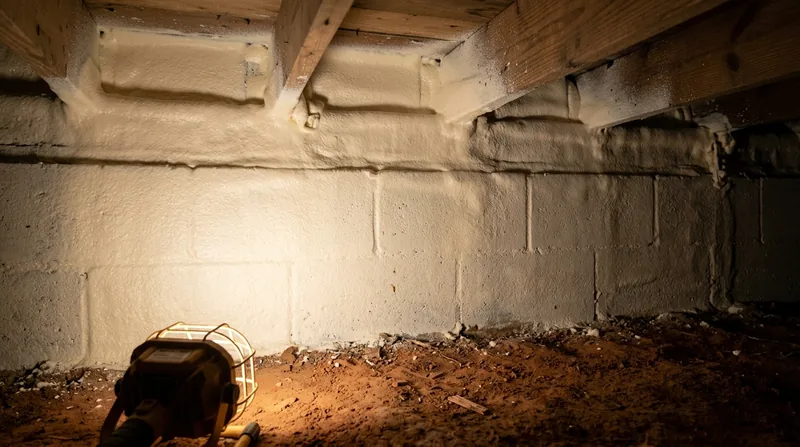




Closed cell spray foam insulation in Greensboro is engineered to handle the exact moisture and pest pressures that Piedmont homes face. Greensboro's vented crawl spaces pull damp outside air under the floor throughout the humid summer, and in winter that moisture reverses direction, driving cold and musty conditions into living spaces above. The region's red clay terrain, combined with hot summers full of thunderstorms and mild winters that still bring occasional ice, creates a demanding environment for any insulation system. Closed cell foam resists moisture infiltration, stands firm against the pressure of damp crawl space air, and holds its R-value in the face of seasonal vapor drive. Whether your home sits in Fisher Park, Sunset Hills, or one of the newer subdivisions toward Summerfield and Oak Ridge, the physics of moisture and air sealing start at the band joist, the attic plane, and the crawl space. We help Greensboro homeowners and builders seal those boundaries with closed cell spray foam, backed by a written estimate that specifies R-value and thickness.
Why Closed Cell Spray Foam Matters in Greensboro's Humid Climate
Closed cell foam is denser and more rigid than open cell. Its structure resists moisture penetration and does not absorb water, making it the right choice for spaces that face constant damp air or seasonal condensation. In Greensboro, that means crawl spaces, rim joists, and block foundation walls where moisture and pest pressure are facts of life, not edge cases. The foam also provides structural bracing on walls and attics, a bonus that open cell cannot match. Because closed cell cures to a solid, impermeable mass, it also blocks air leakage more effectively in a single pass, which matters when you are sealing a rim joist or a block wall in a 1950s ranch or a mid-century bungalow.
- Closed cell foam resists moisture and does not absorb water, critical in Greensboro's vented crawl spaces where damp air is constant.
- The foam provides an air seal in a single application, stopping infiltration at the rim joist and band joist without requiring additional membranes.
- Its higher density and rigidity add structural strength to walls and attics, bracing block walls and rim joists against seasonal movement.
- Closed cell stands up to pest pressure and does not degrade when exposed to the humidity and temperature swings of Guilford County crawl spaces.
These qualities make closed cell the standard choice for rim joists, crawl space walls, and block foundation work across Greensboro and Alamance County.
Key info: Greensboro sits in IECC climate zone 4A, mixed-humid Piedmont. The moisture regime here is driven by vented crawl spaces breathing damp outside air under the floor, especially in summer. Closed cell foam, applied to rim joists and crawl space walls, stops that air and moisture infiltration at the source. Open cell cannot do this job safely; closed cell is the code-compliant and durable choice.
For a detailed look at how moisture and air sealing work together, see our page on crawl space spray foam insulation, where the same principles apply to the entire below-floor boundary.
How We Install Closed Cell Spray Foam in Greensboro Homes
Our process starts with a site visit to assess the substrate, the scope of work, and any moisture or ventilation issues that must be addressed before foam is applied. We measure the space, determine the R-value and thickness needed to meet code and your performance goals, and provide a written estimate with those specs spelled out. On installation day, we set up mechanical ventilation to manage fumes during cure, apply the foam at the manufacturer's ratio and temperature, and control thickness per pass to ensure a uniform, code-compliant result. After the foam cures, we allow a re-entry window of 24 to 48 hours before the space is occupied, and we remain reachable if questions arise.
- We inspect the substrate for moisture, contamination, or structural issues that could compromise the foam bond or performance.
- We calculate the R-value and thickness required by code and your climate zone, and we document both in the written estimate.
- We apply closed cell foam using drum-fed equipment, maintaining the manufacturer's ratio and temperature throughout the job.
- We operate mechanical ventilation during cure and specify a re-entry window so occupants know when the space is safe to use again.
- We provide a written workmanship warranty covering the installation, and we remain available for any follow-up questions or concerns.
This methodical approach is what separates a durable, code-compliant installation from a quick spray-and-leave job that leaves homeowners wondering why the smell lingers or the performance falls short.
Example: A 1950s ranch in Sunset Hills has a vented crawl space with damp air and visible moisture on the rim joist. We apply closed cell foam to the rim joist and the upper band area, sealing the air leakage path and stopping moisture from wicking into the rim board and the wall framing above. The foam is 2 inches thick, R-13 minimum, installed at the manufacturer's ratio with mechanical ventilation running during cure. The homeowner waits 24 hours before the space is occupied, and the cold floors and musty smell improve within days.
For more on the air sealing side of this work, see our air sealing service page.
Closed Cell Spray Foam Applications and Methods
| Application | Description | Best for |
|---|---|---|
| Rim Joist and Band Joist Sealing | 2-inch closed cell foam applied to the rim board and band area where the foundation meets the house frame, sealing air leakage and blocking moisture infiltration. | 1920s to 1980s homes across Greensboro with uninsulated or poorly insulated rim joists; the single biggest air leak in most older homes. |
| Crawl Space Wall Insulation | Closed cell foam sprayed on the interior face of block or concrete crawl space walls, stopping moisture and air infiltration from the damp soil and outside air. | Vented crawl spaces across Guilford County and Alamance County with red clay terrain and high humidity; the standard approach for moisture control in this climate zone. |
| Injection Foam Retrofit in Walls | Closed cell foam injected into cavities of exterior walls without demolition, filling empty or poorly insulated cavities in pre-1980 stock and adding structural bracing. | Fisher Park and Irving Park bungalows, Lindley Park and Sunset Hills mid-century ranches with plaster or brick exteriors and little or no cavity insulation. |
| Attic Rim and Soffit Sealing | Closed cell foam applied to the attic rim, soffit, and any ductwork or penetrations to seal air leakage before blown-in or additional foam is installed above. | Newer two-story homes with rooms over garages and ductwork running through unconditioned attic space; the prep work for a sealed attic or a high-performance retrofit. |
| Metal Building and Barndominium Insulation | Closed cell foam applied to the interior of metal roof decks and walls, controlling condensation and providing continuous insulation without thermal bridging through steel. | Metal buildings, pole barns, and barndominiums in High Point, Kernersville, and Jamestown where condensation on steel is the dominant failure mode. |
Closed Cell Spray Foam Insulation Cost in Greensboro: What to Expect
Closed cell spray foam is priced per board foot, measured on site after application. The starting point for most residential work in Greensboro is around $1.20 per board foot, but the final cost depends on several concrete factors. Rim joist work in a 1,200-square-foot ranch might run 30 to 50 board feet, while crawl space walls in a larger home can push 200 to 400 board feet. The substrate condition matters too: a clean rim joist takes less time and material than one with old insulation or debris that must be cleared first. Access also affects cost. A rim joist on a crawl space with headroom and a clear work path is faster and cheaper than one in a tight, wet, or cluttered space. Thickness and R-value requirements are set by code and your climate zone, so those are fixed. The best way to understand your actual cost is to get a written estimate from us that spells out board feet, R-value, and thickness, so you are not guessing.
We recommend getting 2 to 3 estimates from different contractors so you can compare not just price, but the specs and the approach. A vague estimate with no R-value and no thickness is a red flag. A price far below market with no inspection or mechanical ventilation during cure is another warning sign. A contractor who promises immediate re-entry or claims the foam is 100% safe and non-toxic is not being honest about the product or the process. Our pricing page has more detail on typical costs for different applications, and you can always call us at (336) 833-1513 for a free, no-obligation estimate.
Closed Cell Spray Foam Insulation Near Me: What Greensboro Homeowners Should Know When Hiring
Spray foam insulation is not a commodity. The quality of the installation depends entirely on the contractor's knowledge, equipment, and discipline. When you are looking for a closed cell spray foam contractor in Greensboro, High Point, Kernersville, or any of the surrounding areas, there are a few concrete things to verify. First, confirm that the contractor is fully insured and can provide a current certificate of insurance on request. Second, ask for a written estimate that includes R-value, thickness, board footage, and the specific application method. If a contractor cannot or will not provide those details, walk away. Third, check references from recent jobs in your area. Talk to homeowners who had the same work done and ask about the smell, the re-entry timeline, and whether any issues came up after the job was finished. Fourth, understand your local permitting requirements. Greensboro, High Point, Kernersville, and other cities in Guilford and Alamance counties have their own building departments and their own rules about attic ventilation, ignition barriers, and thermal barriers. The contractor should be familiar with those rules and should help you navigate what applies at your address, but the final say rests with the local building official, not the contractor. If you have an HOA, check the architectural guidelines for any exterior work on metal buildings or additions. Most HOAs do not touch insulation, but it is worth asking.
- Ask for a written estimate with R-value, thickness, and board footage spelled out, never a price per square foot or a vague range.
- Confirm that the contractor is fully insured and ask for a current certificate of insurance before work begins.
- Request references from recent jobs in Greensboro, High Point, or Kernersville, and call them to ask about the re-entry timeline and any issues after the job.
- Understand your local building code and permitting requirements by contacting the building department at your city or county, and ask the contractor to confirm what applies to your job.
- Check your HOA architectural guidelines if you live in a master-planned community, especially for exterior work on metal buildings or additions.
The contractor you choose should be reachable, transparent about the process, and willing to explain what they are doing and why. If something smells wrong during or after the job, you should be able to call them and get a straight answer. That is the standard, and it is what we aim for every time.
Ready to get started? Contact us for a free estimate or call (336) 833-1513. We serve Greensboro, High Point, Kernersville, Burlington, Winston-Salem, Jamestown, Archdale, Thomasville, and surrounding areas in Guilford, Alamance, Forsyth, Randolph, and Davidson counties.
Closed Cell Spray Foam Insulation in Greensboro: Pricing Guide
| Service | Price | Details |
|---|---|---|
| Rim Joist and Band Joist Sealing | Starting at $1.20/board ft | Typical job 30 to 50 board feet depending on home size and rim accessibility in crawl space |
| Crawl Space Wall Insulation | Starting at $1.20/board ft | Larger scope, typically 200 to 400 board feet; substrate condition and access to walls affect final board foot count |
| Injection Foam Retrofit in Walls | Starting at $1.20/board ft | Pre-1980 homes with empty cavities; drilling and injection add labor, board footage depends on wall area and cavity depth |
| Metal Building and Barndominium Insulation | On estimate | Scope and height of installation require site visit to assess roof deck area, existing condensation, and access equipment needed |
| Travel and Setup | Included | No separate mileage fee within Greensboro and surrounding service area; setup and mechanical ventilation included in board foot pricing |
| Written Estimate | Free | Includes R-value, thickness, board footage, and application method; response within 24 hours, no obligation to book |
Indicative pricing, the exact cost depends on square footage, finish, and site access. Free personalized estimate within 24h at (336) 833-1513.


