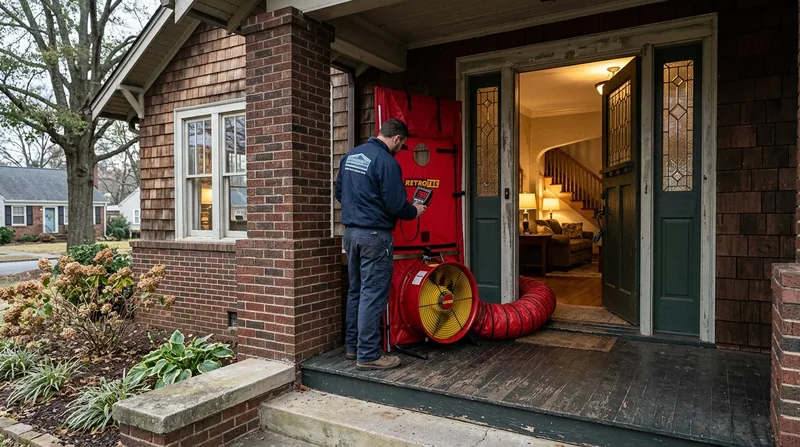




Air sealing in Greensboro stops the drafts and moisture movement that plague homes across the Piedmont, from the 1920s bungalows in Fisher Park to the mid-century brick ranches in Lindley Park and the newer subdivisions stretching toward Summerfield and Oak Ridge. Greensboro sits in IECC climate zone 4A, mixed-humid territory where hot, wet summers push damp air up through vented crawl spaces and under floors, while winter drafts pull that moisture right back down through gaps at the top plate, band joist, and attic rim. Those gaps are not small: a blower door test on an unsealed older home often shows air leakage equivalent to leaving a window cracked open year-round. Sealing those spots with spray foam closes the stack effect that drives heating and cooling loss, lowers your blower door number, and stops the seasonal moisture cycle that leaves cold floors and musty air. We help homeowners across Greater Greensboro and into Alamance, Forsyth, Randolph and Davidson counties plug those leaks at the source, not just patch the symptoms.
Why Air Sealing Matters in Greensboro's Mixed-Humid Climate
Greensboro's housing stock sits on red clay with vented crawl spaces that breathe humid outside air directly under your floors. In summer, that air is warm and wet; in winter, it cools and reverses direction, pulling moisture up into the living space. Meanwhile, ductwork in attics and rooms over garages sit in unconditioned space, and the stack effect pulls air up through every gap in the top plate and rim joist. Air sealing closes those gaps before they become a conditioning problem or a moisture problem.
- Stops the stack effect that pulls damp crawl space air into living spaces during winter and shoulder seasons.
- Seals gaps at the top plate, band joist, and attic rim where drafts escape in winter and humid air enters in summer.
- Works in tandem with spray foam insulation to lower blower door test numbers and improve energy performance.
- Reduces the load on HVAC systems by stopping air leakage through structural cavities and rim board voids.
- Protects wall and attic cavities from moisture-driven air movement that can degrade fiberglass or other existing insulation.
Proper air sealing is the foundation of any insulation retrofit in the Piedmont; without it, you are conditioning the outdoors instead of the house.
Key info: North Carolina building code and the IECC govern attic ventilation, ignition barriers, and thermal barrier requirements at your address. The local building official in Greensboro, High Point, Kernersville, or wherever your home sits determines what applies to your job. We help you navigate those rules, but the building department always has the final say. Always check with your city or county before any work begins.
For detailed guidance on what your city requires, contact the City of Greensboro Permitting and Inspections office or your local building department.
How We Air Seal Homes in Greensboro: Our Process
Air sealing starts with a blower door test or a visual inspection to identify the biggest leaks. In older Greensboro homes, those are almost always at the rim joist, the top plate where the walls meet the attic, and around ductwork penetrations. We seal those spots with spray foam, focusing on the cavities and gaps where air actually moves, not just surface cracks. The work takes a day or two depending on the size of the home and the number of zones that need sealing.
- Inspect the attic, crawl space, band joist, and rim board to locate the biggest air leaks using a blower door or visual assessment.
- Seal cavities, gaps, and rim voids with closed-cell or open-cell spray foam, depending on the location and moisture exposure.
- Apply a thermal barrier over any exposed foam in attics, crawl spaces, or living areas per code requirements at your address.
- Test and verify the work with a follow-up blower door if requested, confirming the improvement in air tightness.
- Provide written documentation of the R-value, thickness, and coverage so you have a record for your file.
The result is a measurable drop in air leakage and a house that holds temperature and humidity more predictably through Greensboro's hot, wet summers and cool winters.
Local example: A 1950s brick ranch in Lindley Park with vented crawl space, ductwork in the attic, and no insulation in the walls typically has rim joist gaps you can see daylight through. Air sealing that rim, the top plate, and the crawl space rim board stops the cold floor problem and lowers the blower door number by 30 to 50 percent. The same work on a newer two-story in Summerfield often focuses on the attic rim, band joist, and the rim joist over the garage, which is the biggest source of conditioned air loss.
For more detail on how spray foam insulation complements air sealing, see our page on attic spray foam insulation in Greensboro.
Air Sealing Methods and Where They Work Best
| Approach | Description | Best for |
|---|---|---|
| Closed-cell spray foam | High-density foam, 1.5 to 2 lb/cf, R-6 to R-7 per inch, vapor barrier, moisture-resistant. | Rim joists, band joists, crawl space rim, areas exposed to moisture or vapor drive. |
| Open-cell spray foam | Lower-density foam, 0.5 to 0.6 lb/cf, R-3.5 to R-4 per inch, vapor-permeable, cost-friendly. | Attic rim, top plate cavities, interior walls where vapor needs to escape, budget-conscious retrofits. |
| Backer rod and caulk | Foam backer rod fitted into large gaps, sealed with polyurethane or silicone caulk, no spray equipment. | Large rim cavities, band joist voids, attic rim gaps where spray foam is impractical or over-specified. |
| Spray foam + thermal barrier | Closed or open-cell foam applied to rim, rim joist, or top plate, then covered with 15-minute thermal barrier or ignition barrier per code. | Any air sealing in attics, crawl spaces, or living areas where code requires foam to be protected from ignition. |
The choice between closed-cell and open-cell depends on moisture exposure, budget, and whether the foam will be in a vented or sealed space. In Greensboro's mixed-humid climate, closed-cell is the safer choice for rim joists and crawl space rim because it handles the seasonal moisture swing. Open-cell works well for attic rim and top plate cavities where the attic is vented and vapor can escape freely.
Air Sealing Cost in Greensboro: What to Expect
Air sealing jobs in Greensboro typically start at $650 to $1,200 for a single zone (rim joist, attic rim, or top plate), depending on the size of the area, access, and whether you choose closed-cell or open-cell foam. A whole-house air sealing that includes rim joist, band joist, attic rim, and top plate cavities usually runs $2,000 to $4,500. The biggest cost drivers are the linear footage of rim board, the depth and condition of the cavities, and whether existing insulation or debris needs to be cleared first.
Homes with accessible crawl spaces and clear rim board cavities are faster and less expensive than homes where the rim is blocked by debris, old insulation, or difficult access. A 1950s ranch with a vented crawl space and exposed rim board will cost less to seal than a newer two-story where the rim is tucked behind brick or siding and requires partial demolition to reach. We always provide a written estimate with R-value, thickness, and coverage so you know exactly what you are paying for.
For a full pricing overview and to request a free, no-obligation estimate, visit our pricing page or call us at (336) 833-1513. We respond within 24 hours and can usually schedule a job within one to two weeks.
What to Look for When Hiring an Air Sealing Contractor Near Greensboro
Air sealing is a small-ticket service, but it is also a credibility test. A contractor who cuts corners on air sealing (no R-value spec, no thickness documentation, no thermal barrier where code requires it) is cutting corners everywhere. When you are interviewing spray foam contractors in Greensboro, High Point, Kernersville, or anywhere else in the region, ask for three things: a written estimate with R-value and thickness, proof of full insurance coverage, and references from recent jobs in your neighborhood.
- Verify that any contractor you hire carries full insurance and can provide a current certificate of insurance before work begins.
- Get written estimates from at least two or three contractors, each with R-value, thickness, and coverage area clearly stated.
- Ask for references from homeowners in Greensboro, Lindley Park, or your specific neighborhood, and follow up with at least one recent job.
- Understand whether your city requires a permit for air sealing work and confirm that the contractor will help you navigate local requirements.
- Check whether your HOA or homeowner association has rules about exterior work, especially if you live in a master-planned community like Summerfield or Oak Ridge.
- Ask about mechanical ventilation during application and the re-entry window; honest contractors specify 24 to 48 hours before the space is safe to occupy.
The contractor should never promise a lifetime warranty (one to three years on workmanship is standard), never quote a price per board foot without seeing the job first, and never guarantee energy savings as a percentage or dollar amount. If a contractor makes any of those claims, walk away and call someone else.
Ready to get started? Contact us for a free estimate, or call (336) 833-1513 to discuss your air sealing needs. We are fully insured and have been serving Greensboro and the surrounding counties since 2016.
Air Sealing in Greensboro: Pricing Guide
| Service | Price | Details |
|---|---|---|
| Single zone air sealing (rim joist, attic rim, or top plate) | Starting at $650 | Closed or open-cell foam seal of one area; cost rises with linear footage and cavity depth |
| Whole-house air sealing (rim, band joist, attic rim, top plate) | Starting at $2,000 | Multiple zones sealed in one visit; final price depends on home age, footprint, and access difficulty |
| Crawl space rim and band joist sealing | Starting at $800 | Closed-cell foam for moisture resistance; price varies with crawl space size and rim board condition |
| Attic rim and top plate with thermal barrier | Starting at $900 | Foam plus code-required thermal barrier; cost depends on attic size and complexity of cavity geometry |
| Travel and estimate | Included in estimate | No separate mileage charge for Greensboro and surrounding service area; free estimate within 24 hours |
Indicative pricing, the exact cost depends on square footage, finish, and site access. Free personalized estimate within 24h at (336) 833-1513.


