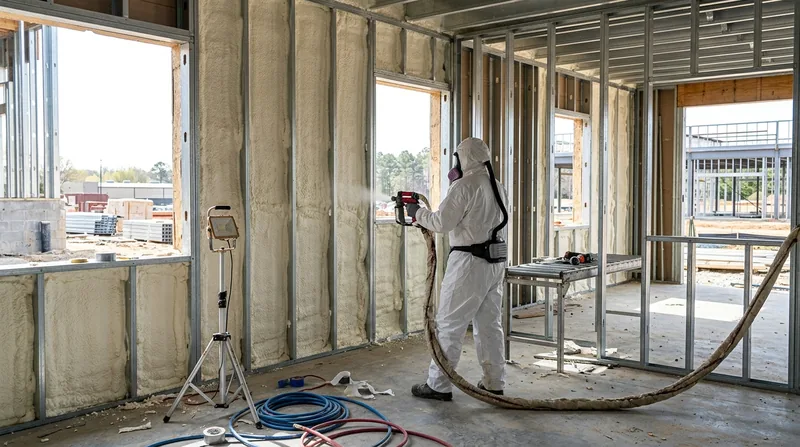




New commercial builds and residential additions across Guilford County face the same mixed-humid Piedmont climate challenges as the established housing stock: hot, humid summers that drive cooling loads through poorly sealed attics and rim joists, and short but punishing winters where moisture swings reverse direction. Whether you are building a new office shell in Greensboro, adding a second story over a garage in High Point, or framing a metal building in Kernersville, commercial and new construction spray foam insulation sized to the energy code that applies at your address is the difference between a building that holds its conditioning and one that bleeds energy from day one. We insulate new builds, additions, and commercial shells with closed cell and open cell foam, sealed roof decks, and complete air sealing to meet or exceed the IECC standard for your location.
Why Commercial and New Construction Spray Foam Matters in Greensboro and the Piedmont
The Piedmont's mixed-humid climate is unforgiving to thermal leakage. Summer heat radiates through attics and roof decks into living space; winter moisture migrates from outdoors into walls and band joists when interior air is cold and dry. New construction framed in 2024 is built to an energy code that did not exist in 1980, and that code assumes continuous insulation with air sealing, not fiberglass batts with gaps. A builder or property manager who specifies spray foam from the start avoids the retrofit cost later and captures the performance from day one.
- Sealed roof decks and attics eliminate the thermal bypass of vented attic space in summer and the moisture drive in winter.
- Spray foam bonds to rim joists, band joists, and header beams, closing the air leakage path that fiberglass cannot seal.
- New metal buildings and barndominiums require closed cell foam on the interior or exterior to prevent condensation on steel and rust.
- Wall cavities in new construction sprayed with injection foam before drywall hang eliminate the voids and settling that plague blown-in retrofits.
- Commercial shells insulated at the time of framing lock in the building envelope before mechanical, electrical, and plumbing trades compromise it.
Specifying spray foam in new construction is the clearest path to a code-compliant, durable, and energy-efficient building from the ribbon cutting forward.
Key info: North Carolina's energy code is the International Energy Conservation Code (IECC) as adopted by your local jurisdiction. Greensboro, High Point, Burlington, and Winston-Salem each have their own building department and may enforce different code years. We review the code in force at your address before the estimate.
For more detail on the science of sealed attics and the Piedmont climate, see our attic spray foam insulation page.
How We Insulate New Construction and Commercial Shells in Greensboro
New construction spray foam work begins with the building framing and the energy code that applies at your site. We work from the plans and the code to specify the foam type, R-value, and thickness required. For sealed attics and roof decks, we spray closed cell or open cell foam directly to the roof sheathing, creating an unvented conditioned attic. For walls, we inject foam into the cavities before drywall. For metal buildings, we apply closed cell foam to the interior of the steel frame to stop condensation. For rim and band joists, we spray foam directly into the cavity to create a continuous thermal and air barrier.
- We review the IECC code for your address and confirm the R-value and thickness required.
- We schedule the spray work to coincide with the framing stage, before other trades close the cavities.
- We spray the foam at the correct ratio, temperature, and thickness per pass, ensuring full expansion and cure.
- We provide a written estimate with R-value and thickness specifications so the builder and inspector know exactly what was installed.
- We coordinate with the builder and the building inspector to confirm compliance before final inspection.
The result is a building envelope that meets code on day one and holds its performance for decades.
Example: A new two-story home in Jamestown with a sealed attic and rim joist foam requires closed cell foam at 1.5 inches (R-7.7 per inch) on the roof deck to meet the 2024 IECC for zone 4A, plus 2 inches on the rim joists. We spray both in a single day while the framing is open, providing the builder with a written spec sheet for the inspector.
For guidance on closed cell spray foam and its R-value performance, see our dedicated service page.
Spray Foam Methods for New Construction: Closed Cell, Open Cell, and Injection
| Method | Description | Best for New Construction |
|---|---|---|
| Closed Cell Spray Foam | Dense, rigid foam with high R-value per inch (6.5 to 7.7 R per inch). Acts as an air barrier and vapor barrier. Requires mechanical ventilation during cure and a 24 to 48 hour re-entry window. | Sealed roof decks, rim and band joists, metal buildings, and any cavity where moisture control and high R-value in a thin profile matter. |
| Open Cell Spray Foam | Lighter, softer foam with lower R-value per inch (3.6 to 3.8 R per inch). Vapor-permeable, allowing wall cavities to dry to the interior. Faster cure and lower cost per board foot. | Attics and interior walls in new homes where vapor permeability is desired and high R-value per inch is not the constraint. |
| Injection Foam | Low-pressure foam injected into wall cavities before drywall. Fills the cavity completely, eliminating voids and settling risk. Cures within hours. | New construction wall cavities before drywall hang, ensuring uniform density and no compression loss over time. |
| Rim and Band Joist Foam | Closed cell foam sprayed directly into the cavity between the sill plate and the band joist. Creates a thermal and air barrier at the most critical thermal bridge in the building. | All new construction with a rim joist or band joist, whether above a crawl space, basement, or slab. Non-negotiable for energy code compliance in zone 4A. |
Commercial and New Construction Spray Foam Cost in Greensboro: What to Expect
The cost of spray foam insulation for new construction depends on the scope: the square footage of attic or roof deck, the wall cavity volume, the metal building footprint, and the R-value and foam type required by code. A new home with a sealed attic, rim joist foam, and wall cavity injection will cost more than a simple attic top-up, but the cost is incurred once during framing and adds durability and energy performance that last the life of the building.
We provide a free commercial estimate with written R-value and thickness specifications. The estimate includes a site visit, a review of the code for your address, and a firm quote for the scope of work. Most new construction estimates are returned within 24 hours. Factors that affect cost include the total square footage of foam, the foam type (closed cell is more expensive per board foot than open cell), the complexity of the roof or wall geometry, and the access and logistics on the job site.
For detailed pricing information and a breakdown of what moves cost up or down, see our full pricing page. If you are a builder or property manager working on a new project, call us at (336) 833-1513 to discuss your plans and get a quote in writing.
What to Look for When Hiring a Spray Foam Contractor Near Greensboro for New Construction
The spray foam market includes local shops, national franchises, and out-of-state rig-and-run crews. A local contractor with skin in the game and a local address is the safest choice. When you call a spray foam contractor, ask for three things: a written estimate with R-value and thickness specs, proof of insurance with the builder or property owner listed as an additional insured, and a reference from a recent new construction or commercial project in your area.
Verify that the contractor is familiar with the energy code in force at your address. Greensboro, High Point, Burlington, Jamestown, Archdale, and other cities in Guilford and Alamance counties may enforce different code years, and the contractor should know which one applies to your job. Ask about the cure protocol: mechanical ventilation during spray, the re-entry window (24 to 48 hours), and any thermal barriers or ignition barriers required by code. If the estimate has no R-value or thickness, no re-entry window, or a price far below market, walk away.
For a free estimate and a discussion of your new construction or commercial project, contact us online or call (336) 833-1513. We will review your plans, confirm the code for your address, and provide a written quote with full specifications.
Commercial & New Construction Spray Foam in Greensboro: Pricing Guide
| Service | Price | Details |
|---|---|---|
| New construction sealed attic | Free commercial estimate | Closed cell or open cell foam sized to code, written R-value and thickness specification, builder coordination |
| Rim and band joist foam | Free commercial estimate | Closed cell foam in rim cavity, air sealing at sill and header, code compliance verification for zone 4A |
| Wall cavity injection foam | Free commercial estimate | Low-pressure injection before drywall, uniform density, no settling, complete cavity fill |
| Metal building or barndominium | Free commercial estimate | Closed cell foam on interior or exterior of steel frame, condensation control, thermal performance to code |
| Commercial shell or large multi-story addition | On estimate | Site visit required to assess framing stage, code requirements, logistics, and access before quote |
| Estimate and consultation | Free | Response within 24 hours, written specifications, no obligation, (336) 833-1513 |
Indicative pricing, the exact cost depends on square footage, finish, and site access. Free personalized estimate within 24h at (336) 833-1513.


