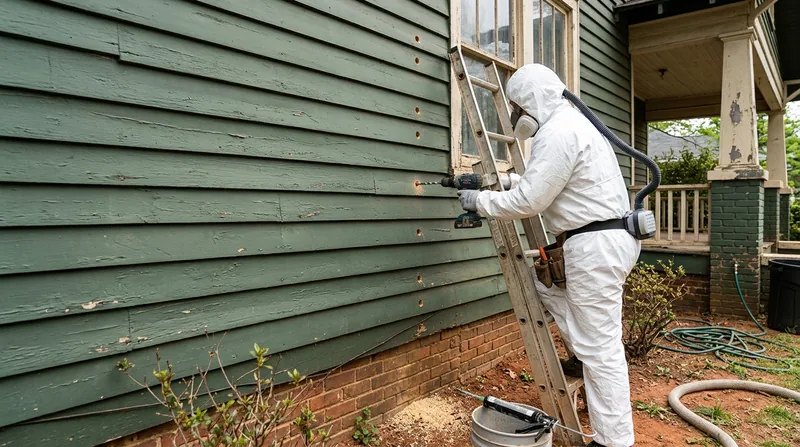




Wall and injection foam insulation in Greensboro reaches the empty stud cavities behind original plaster and siding in the 1920s and 1930s bungalows of Fisher Park and Irving Park, and in the mid-century brick ranches scattered across Lindley Park, Sunset Hills, and Starmount. These homes were built when insulation was a luxury, not a code requirement, and their walls sit uninsulated or nearly so, driving heating and cooling bills year-round in Piedmont's mixed-humid climate. Injection foam fills those cavities without tearing out original plaster or disturbing historic siding, restoring thermal control to walls that have leaked energy for decades. This is the retrofit answer for older Greensboro homes where tearing walls open is not an option, and where the cost and disruption of full demolition would exceed the value of the work itself. We drill small holes, inject foam into the cavity, seal the holes, and leave your home's character intact.
Why Wall Injection Foam Matters in Greensboro's Historic Neighborhoods
Greensboro's oldest residential stock, from the bungalow belt near downtown to the Irving Park and Fisher Park neighborhoods, carries walls with no insulation or with mineral wool batts that have settled and compressed over eighty or ninety years. The climate here is mixed-humid Piedmont: hot, humid summers with thunderstorms that drive moisture into walls, and short winters cold enough to create condensation on the inside of uninsulated cavities. Empty walls in these homes bleed heating in winter and pull in outside heat in summer. Injection foam stops that flow without requiring you to sacrifice the plaster, the original trim, or the exterior character that defines these neighborhoods.
- We drill 1-inch holes at 16-inch intervals through the exterior or interior, depending on access and what protects the wall finish.
- Injection foam fills the cavity completely, expanding to seal air gaps and compress any existing, failed insulation.
- We seal the holes with matching plugs or caulk, leaving no visible trace on historic plaster or period siding.
- The process takes hours, not days, and requires no interior demolition or disruption to your living space.
This method is the only practical way to insulate the walls of a 1930s bungalow or a 1950s ranch without gutting them.
Key info: A typical Fisher Park or Irving Park bungalow with 2,000 square feet of exterior wall may need 40 to 80 board feet of injection foam, depending on cavity depth and existing insulation. Costs run from $2 to $4 per board foot for injection work, plus the cost of any interior access drilling or exterior repair. The payoff is walls that no longer leak, and a home that stays warm in winter and cool in summer without gutting the original plaster.
For context on how injection foam fits into your overall insulation strategy, see our air sealing service page, which addresses the gaps and leaks that injection foam alone cannot reach.
How We Inject Foam Into Your Greensboro Home's Walls: Step by Step
Injection foam work starts with a careful survey of the wall. We identify the cavity depth, check for existing insulation, look for moisture or settling, and plan hole placement to minimize visible damage and maximize foam coverage. Access may come from inside or outside depending on the wall finish, the location of the cavity, and what the homeowner prefers. Once we confirm the cavity is dry and ready, we inject foam at a controlled rate, monitoring pressure and expansion to fill the space without over-pressurizing the wall.
- We visit your home, inspect the walls, and identify the cavities to be filled.
- We determine the best access route (interior or exterior) and plan drilling to minimize visible patching.
- We set up injection equipment, confirm the foam system is at the correct drum temperature and ratio, and test on scrap.
- We drill access holes, inject foam at controlled pressure, and monitor expansion until the cavity is full.
- We seal all holes with foam plugs or caulk, and patch any exterior damage if drilling came from outside.
- We ventilate the space and confirm the homeowner understands the 24 to 48-hour re-entry window before the foam is fully cured.
The entire process is non-invasive and leaves your walls, plaster, and siding intact.
Example: A 1950s ranch in Sunset Hills with 2,500 square feet of wall area and empty stud cavities in the exterior walls. Injection foam fills all four walls to an average depth of 3.5 inches. The job takes one day, costs $800 to $1,200 depending on access, and cuts heating and cooling load on those walls by 60 to 75 percent. The homeowner sees lower bills within the first heating season.
For a broader look at how walls fit into your home's thermal envelope, see our attic spray foam insulation page, which addresses the other major source of energy loss in Greensboro homes.
Injection Foam Methods and Applications
| Approach | Description | Best for |
|---|---|---|
| Open-cell injection | Lower-density foam (0.5 to 1.5 lb/cu ft) injected into cavities, expands to fill gaps, absorbs moisture. | Interior walls, sound dampening, retrofit where vapor permeability is acceptable. |
| Closed-cell injection | Higher-density foam (2 to 3 lb/cu ft) injected into cavities, creates vapor barrier, resists moisture. | Exterior walls, basements, walls at risk of moisture, walls where air leakage is the primary concern. |
| Cavity-fill with existing insulation | Injection foam combined with existing batts or blown-in insulation, fills voids and air gaps. | Walls with partial insulation, settlement, or air gaps around existing batts. |
| Rim and band joist injection | Injection foam fills the band joist cavity between first-floor and rim, seals air leakage. | Cold first floors, basement chill, air infiltration from the band joist, rim joist in older homes. |
Wall and Injection Foam Insulation Cost in Greensboro: What to Expect
Injection foam insulation in Greensboro typically runs from $2 to $4 per board foot, with most wall retrofit jobs landing between $1,500 and $3,500 depending on the total cavity volume, access difficulty, and whether drilling comes from inside or outside. A smaller job, such as injecting a single wall section or a rim joist, may cost $800 to $1,200. Larger projects covering all four exterior walls of a full-size home can reach $4,000 to $6,000 or more. The key variables are cavity depth (3.5 inches versus 5.5 inches changes the board-foot count significantly), the presence of existing insulation (which reduces the volume to fill), and access complexity (interior drilling is usually faster than exterior drilling and patching).
We always provide a written estimate that specifies the R-value, thickness, and total board feet of foam, so you know exactly what you are paying for. Travel is included within Greensboro and surrounding areas, and the estimate itself is free and carries no obligation. For a detailed look at pricing across all our services, visit our full pricing page.
Getting two or three estimates from different contractors is wise. Beware of estimates with no R-value or thickness listed, prices far below market with no inspection, or promises of savings that sound too good to be true. The cheapest bid is rarely the best value in spray foam work.
Wall and Injection Foam Insulation Near Me: What to Look for When Hiring a Contractor in Greensboro
When you are ready to hire a contractor for wall injection foam in Greensboro or nearby areas like High Point, Kernersville, or Winston-Salem, verify that the company is fully insured and ask to see the certificate of insurance. Check references from recent jobs in your neighborhood, and ask those homeowners whether the work was clean, the smell was manageable, and the contractor was reachable after the job was done. Ask whether the contractor helped navigate local permitting or simply showed up and sprayed. In Greensboro, the building code and any thermal barrier or ignition barrier requirements are set by the City of Greensboro Building Standards, and your contractor should be able to name those requirements and explain how the job will meet them. If you live in an HOA community, especially in master-planned areas, check whether exterior work requires architectural approval before drilling begins.
- Verify that the contractor carries full insurance and can provide a current certificate before the job starts.
- Ask for written estimates that list the R-value, thickness, and total board feet of foam to be installed.
- Request references from at least two recent wall injection jobs in Greensboro or nearby cities and follow up with those homeowners.
- Confirm that the contractor understands the local building code and any thermal barrier rules that apply at your address.
- Ask whether the contractor will provide mechanical ventilation during cure and what re-entry window they recommend (24 to 48 hours is standard).
- Clarify how the contractor will patch holes and what warranty, if any, covers the workmanship (typically one to three years).
A local contractor with a Greensboro address and local plates, who takes time to inspect your walls and answer your questions, is usually a safer choice than a rig-and-run crew from out of state or a national franchise with no local accountability.
Ready to get started? Contact us for a free estimate at (336) 833-1513, and we will walk you through the process and answer any questions about your specific walls.
Wall & Injection Foam Insulation in Greensboro: Pricing Guide
| Service | Price | Details |
|---|---|---|
| Wall injection foam, open-cell | Starting at $2/board ft | Lower-density foam for interior walls or retrofit where vapor permeability is acceptable, typically 40 to 80 board feet per 2,000 sq ft home |
| Wall injection foam, closed-cell | Starting at $3/board ft | Higher-density foam for exterior walls and moisture-prone areas, creates vapor barrier, typical job 50 to 100 board feet |
| Rim and band joist injection | Starting at $800 | Fills the band joist cavity between first floor and rim, seals air leakage, typical job 15 to 30 board feet |
| Complex retrofit or large wall area | On estimate | Multi-story homes, existing insulation removal, difficult access, or exterior drilling and patching require site inspection |
| Estimate | Free | Written estimate with R-value and thickness specs, response within 24 hours, no obligation to book |
Indicative pricing, the exact cost depends on square footage, finish, and site access. Free personalized estimate within 24h at (336) 833-1513.


