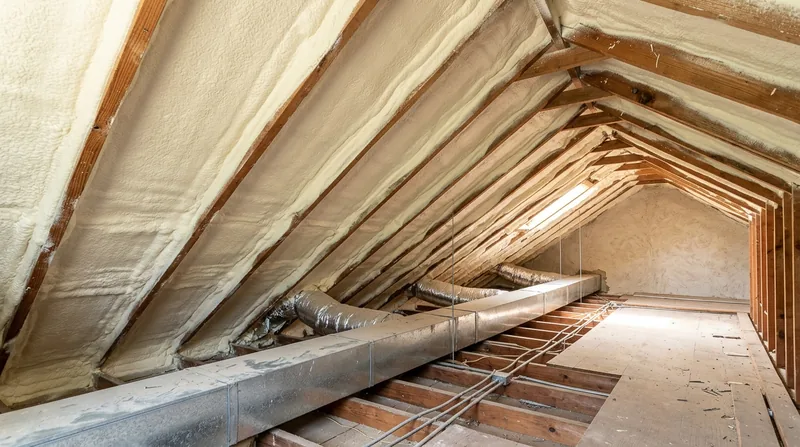




Attic spray foam insulation in Greensboro seals the hot, leaky attics that sit above Fisher Park bungalows, Lindley Park ranches, and newer two-story homes across Guilford County. Greensboro's mixed-humid Piedmont climate means summer heat bakes through unconditioned attic space where ductwork runs, driving cooling bills higher every July and August. Many of these homes were built with little or no insulation in the walls and with vented crawl spaces that breathe damp outside air under the floor. Sealing the attic plane with spray foam cuts cooling loads, stabilizes temperatures, and stops conditioned air from leaking into unconditioned space. We install closed-cell and open-cell foam to the thickness and R-value your home needs, air seal around penetrations, and deliver written estimates that specify the work upfront.
Why Attic Spray Foam Insulation Matters in Greensboro's Heat and Humidity
Greensboro attics trap heat and humidity because the region sits in climate zone 4A with hot, humid summers and short winters that still bring occasional ice storms. Ductwork running through an unconditioned attic loses conditioned air to the hot space around it, forcing your air conditioning to work harder. Older homes in Irving Park, Sunset Hills, and Starmount often have minimal insulation or blown-in fiberglass that settles and leaves gaps. Newer subdivisions toward Summerfield and Oak Ridge add attic ductwork over garages and bonus rooms, multiplying the cooling load. Spray foam seals the attic plane and every penetration where air leaks, holding cool air inside your living space instead of bleeding it into the unconditioned attic.
- We seal the attic plane with closed-cell or open-cell foam to stop hot air from entering living space in summer.
- We air seal around ductwork, electrical penetrations, and rim joists where the attic meets the walls.
- We remove failed or insufficient insulation before installing new foam so the substrate is clean and the new R-value is accurate.
- We verify that mechanical ventilation is in place during the cure period and confirm the re-entry window with you in writing.
Each of these steps is required to deliver the cooling efficiency and air sealing that justifies the investment in spray foam over blown-in fiberglass.
Key info: Greensboro's attic ventilation and thermal barrier requirements are governed by the energy and building code in effect at your address. Always check with your local building department before any work begins. We help you navigate what applies at your location and ensure the installation meets code.
For more on how we approach insulation installation across different building types, see our closed-cell spray foam page, which explains the R-value and moisture control that sealed attics require.
How We Install Attic Spray Foam Insulation in Greensboro: The Process
We start with a free estimate that includes a walk-through of your attic, measurement of the space, and a written specification of the foam type, R-value, and thickness we recommend. On the day of the job, we set up mechanical ventilation to control odor and off-gassing during the cure period. We spray the foam in controlled passes to achieve the exact thickness called for in the estimate, hold the manufacturer drum temperature and ratio, and allow the full cure time before you re-enter the space. A typical attic job in Greensboro takes one to two days depending on size and complexity.
- We inspect the attic substrate for moisture, leaks, or contamination and address any issues before foam is applied.
- We remove existing insulation if it is failed, inadequate, or if the attic is unvented and requires a sealed plane.
- We seal all air leakage points around ductwork, electrical chases, rim joists, and roof penetrations with foam.
- We apply the foam in the thickness and density specified in your written estimate, never rushing or under-applying.
- We document the R-value achieved, the date of application, and the re-entry window so you know when the space is safe to occupy.
This controlled approach is what separates a durable, code-compliant installation from a quick spray that leaves odor, off-gassing, and performance questions.
Example: A 1,500-square-foot attic over a 1960s brick ranch in Lindley Park with existing fiberglass, ductwork, and rim joists requiring air sealing takes about 8 to 10 hours of work, including substrate prep, removal, foam application, and ventilation management. We provide a start date, a completion window, and a clear re-entry timeline so you can plan around the work.
For details on how we handle crawl spaces and rim joists, which often need attention alongside attic work, visit our crawl space insulation page.
| Approach | Description | Best for |
|---|---|---|
| Closed-Cell Spray Foam | High-density foam with an R-value of 6 to 7 per inch. Provides moisture barrier and structural support. Requires skilled application and higher cost. | Sealed attics where moisture control and air sealing are critical, or where the attic will be used for storage or mechanical equipment. |
| Open-Cell Spray Foam | Lower-density foam with an R-value of 3.5 to 3.8 per inch. Allows moisture to pass through and is vapor-open. Lower cost than closed-cell. | Vented attics where the roof deck breathes and where budget is a priority. Sound dampening is a secondary benefit. |
| Foam Over Existing Insulation | A thin layer of open-cell foam sprayed over sound blown-in fiberglass to air seal and add R-value without full removal. | Homes where existing insulation is adequate but air sealing is needed, and budget does not allow full removal and replacement. |
| Full Removal and Replacement | We remove all old insulation, clean the substrate, and install new foam to the specified R-value and thickness. | Attics with failed insulation, settled fiberglass, moisture damage, or where a sealed, unvented attic is required by code. |
Attic Spray Foam Insulation Cost in Greensboro: What to Expect
Spray foam attic insulation in Greensboro starts at around $1.50 per square foot for open-cell foam in a straightforward attic space with good access and minimal substrate prep. Closed-cell foam, which provides a moisture barrier and higher R-value per inch, typically ranges from $2.00 to $3.00 per square foot depending on thickness and the complexity of air sealing required. The actual cost on your job depends on several factors: the size of the attic, the type of foam (open-cell or closed-cell), whether existing insulation needs to be removed, the number of penetrations and ductwork that require air sealing, and the difficulty of access into the space.
A 1,000-square-foot attic with open-cell foam and moderate air sealing might run $1,500 to $2,000. A 1,500-square-foot attic with closed-cell foam, full removal of old insulation, and extensive rim joist sealing could be $3,500 to $5,000 or more. Getting two or three written estimates with R-value and thickness specifications is the smart way to compare. Each contractor should measure your space, specify the foam type and thickness in writing, and explain what is included in the labor and materials.
For a detailed breakdown of pricing across different service types and how to interpret an estimate, visit our full pricing page.
Attic Spray Foam Insulation Near Me: What Greensboro Homeowners Should Know Before Hiring
When you are looking for a spray foam insulation contractor near Greensboro, verify that the company carries full insurance and can provide a current certificate of insurance. Ask for at least two references from jobs completed in the past year in Greensboro or High Point, and follow up with those homeowners about the quality of the work and whether the contractor was responsive after the job. Request a written estimate that specifies the foam type, the R-value, the thickness in inches, and the total square footage being treated. A legitimate contractor will never quote a price without seeing the space and understanding what work is required.
Check whether your attic work requires a permit from your local building department. Permit requirements vary by city across Greensboro, Kernersville, Burlington, and surrounding areas, and there is no reciprocity between jurisdictions. If your home is in a homeowners association, check the HOA rules to see whether exterior work or any visible structural changes require architectural approval. Ask the contractor how they handle mechanical ventilation during the cure period and what re-entry window they recommend before the space is occupied or used for storage.
- Confirm that the contractor provides written estimates with R-value, thickness, and square footage before any commitment is made.
- Verify full insurance coverage and ask for a copy of the insurance certificate with the contractor's name and policy number.
- Get references from homeowners in Greensboro or nearby cities and call them to ask about the quality and responsiveness of the work.
- Understand your local permit requirements by contacting your city building department or HOA before scheduling the job.
- Ask about the contractor's approach to mechanical ventilation during cure and the re-entry window they recommend in writing.
These steps protect you from contractors who spray foam without a plan, rush the cure, or disappear when questions arise after the job.
When you are ready to move forward, contact us for a free estimate. We measure your attic, specify the foam type and R-value in writing, and explain exactly what the job will cost and how long it will take.
Attic Spray Foam Insulation in Greensboro: Pricing Guide
| Service | Price | Details |
|---|---|---|
| Open-Cell Spray Foam Attic | Starting at $1.50/sq ft | Includes substrate inspection, air sealing around penetrations, and mechanical ventilation during cure for vented attics |
| Closed-Cell Spray Foam Attic | Starting at $2.00/sq ft | Includes moisture barrier, higher R-value per inch, full air sealing, and mechanical ventilation for sealed or unvented attics |
| Insulation Removal and Replacement | Starting at $0.75/sq ft removal plus foam cost | Covers labor to remove failed or settled fiberglass, clean substrate, and dispose of old insulation before new foam is applied |
| Rim Joist and Band Joist Air Sealing | Starting at $8.00 per linear foot | Seals the perimeter where attic meets exterior walls to stop air leakage and moisture intrusion at the foundation line |
| Free Written Estimate | No charge | Includes attic measurement, R-value and thickness specification, materials and labor breakdown, and written re-entry timeline |
Indicative pricing, the exact cost depends on square footage, finish, and site access. Free personalized estimate within 24h at (336) 833-1513.


