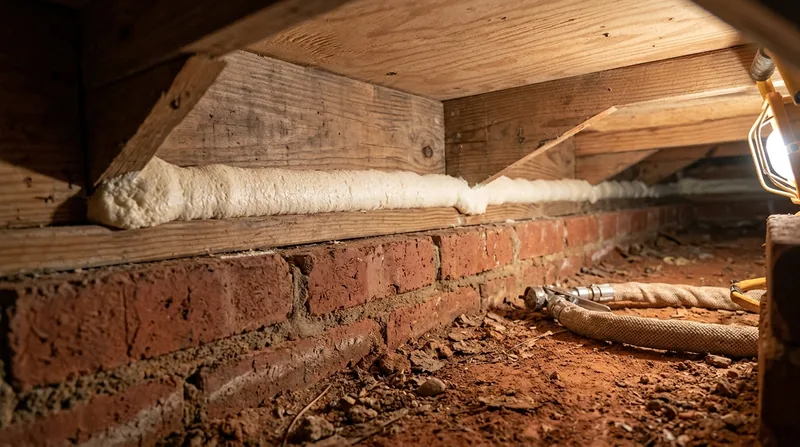




Rim joist and band joist spray foam in Greensboro seals the gap where your home's rim board meets the sill plate, stopping humid summer air from leaking into crawl spaces and basements. This narrow band of wood framing is where Greensboro's hot, damp outdoor air meets the cool interior of your foundation, and it is one of the most common leak points in homes across the Piedmont. Whether your home is a 1930s brick bungalow in Fisher Park, a mid-century ranch in Lindley Park, or a newer two-story in Summerfield, the rim joist is where moisture and drafts begin. Spray foam sealing this junction stops those drafts, reduces the humid air that drives into your crawl space during summer months, and lowers the load on your air conditioning. We spray closed cell or open cell foam directly onto the rim board, air-seal all gaps and cracks, and leave you with a clean, durable thermal and air barrier. Read on to understand why this detail matters in Greensboro's climate, how the work is done, and what to expect when you call.
Why Rim Joist and Band Joist Sealing Matters in Greensboro's Humid Climate
Greensboro sits in IECC climate zone 4A, a mixed-humid Piedmont region where summer air is hot and wet, and that moisture wants to move into your home. The rim joist is the thermal weak point where the wood framing of your crawl space or basement rim sits directly on the masonry or concrete sill. Without sealing, this gap leaks unconditioned outside air into the space below your floors, cooling your crawl space during summer and driving humidity under the house. Cold floors, musty air, and higher cooling bills follow. In older homes with original plaster or brick, rim joists often have no insulation at all. In newer two-story homes, the rim joist above a garage or room addition is a major thermal bridge. Sealing it stops drafts, reduces the damp air that migrates into crawl spaces, and prevents the moisture cycle that starts in summer and reverses in winter.
- Stops humid summer air from leaking into crawl spaces and basement rims.
- Reduces drafts and cold floors in rooms above rim joists.
- Lowers cooling load by sealing one of the home's largest uninsulated gaps.
- Prevents moisture from driving into the foundation space during seasonal humidity swings.
- Works in conjunction with crawl space insulation to create a complete thermal and air barrier below grade.
Sealing the rim joist is one of the highest-return air-sealing moves a Greensboro homeowner can make, and it is often the first step before insulating the crawl space or basement rim.
Key info: Greensboro's red clay Piedmont terrain means most homes sit on vented crawl spaces, not basements or slabs. Those crawl spaces breathe damp outside air in summer and drive moisture upward in winter. Sealing the rim joist stops that air exchange at the source, which is why it is a foundation-level repair in this region.
For more detail on how moisture moves through crawl spaces in Greensboro, see the North Carolina State University extension resources on residential moisture control.
How We Seal Rim Joists and Band Joists in Greensboro
Rim joist sealing is a straightforward air-sealing job that starts with a clean substrate and ends with a sealed, insulated band. We first inspect the rim board for moisture, active leaks, or structural damage. If the wood is wet or the sill is leaking, we stop and recommend that the source be fixed first. Once we confirm a dry substrate, we clean the surface, seal any large gaps with backer rod, and then spray closed cell or open cell foam directly onto the rim board, the band joist, and the sill plate. The foam fills every crack, adheres to the wood and masonry, and creates an air-tight thermal barrier. After the foam cures, we trim it flush and, if required by code, apply a thermal barrier (typically a fire-rated paint or membrane). The job typically takes a few hours for a standard crawl space rim, and you can re-enter the space after 24 to 48 hours.
- We inspect the rim board and sill plate for moisture, leaks, or damage before any work begins.
- We clean the substrate and seal large gaps with backer rod to prevent foam waste.
- We spray closed cell or open cell foam directly onto the rim, band, and sill, filling every crack and void.
- We trim the cured foam flush and apply a thermal barrier if required by your local building code.
- We provide written specifications including foam type, R-value, and thickness so you have documentation for your home.
The entire process is clean, controlled, and leaves no mess in your crawl space or basement. We use mechanical ventilation during and after application to manage any odor, and we follow a stated re-entry window so you know exactly when the space is safe to use.
Example: A 1960s brick ranch in Sunset Hills with a 1,200-square-foot footprint has a rim joist that runs roughly 180 linear feet. We clean the rim board, seal the rim-to-sill junction with closed cell foam at 2 inches thickness, trim it, and apply a thermal barrier. The job takes about 4 to 6 hours and costs from $650 to $1,200 depending on substrate condition and access. The homeowner gets a warmer floor and lower cooling bills immediately.
Rim Joist and Band Joist Spray Foam Methods: Closed Cell vs. Open Cell
| Approach | Description | Best for |
|---|---|---|
| Closed Cell Spray Foam | High-density foam, typically 1.5 to 2 pounds per cubic foot, with an R-value of 6 to 7 per inch. Vapor-impermeable, moisture-resistant, and structural. | Rim joists in vented crawl spaces where moisture control and vapor blocking are priorities. Works well in Greensboro's humid climate. |
| Open Cell Spray Foam | Low-density foam, typically 0.4 to 0.5 pounds per cubic foot, with an R-value of 3.5 to 4 per inch. Vapor-permeable, lightweight, and cost-effective. | Rim joists in conditioned basements or where vapor permeability is acceptable. Lower cost option for air sealing alone. |
| Backer Rod and Sealant | Polyethylene foam rod inserted into large gaps, followed by polyurethane or acrylic sealant. Air-seals without full foam coverage. | Minor gaps or budget-conscious jobs where partial sealing is sufficient. Often used alongside foam on large rims. |
| Injection Foam into Rim Cavities | Low-pressure polyurethane foam injected into hollow rim boards or band joists. Fills the cavity without removing siding or plaster. | Older homes with hollow rim boards and no existing insulation. Works when exterior access is limited. |
For most Greensboro homes with vented crawl spaces, closed cell foam is the standard choice because it stops moisture, provides thermal value, and is durable. Open cell works in conditioned basements or as a lower-cost air seal. We size the foam thickness and type to match your crawl space type and your building code requirements, and we document it all in writing.
Rim Joist and Band Joist Spray Foam Cost in Greensboro: What to Expect
Rim joist sealing in Greensboro typically starts at $650 to $1,200 for a standard crawl space rim on a single-story home. The cost depends on the linear footage of rim, the substrate condition, the foam type and thickness you choose, whether a thermal barrier is required by code, and access to the rim. A 1,200-square-foot ranch with a 180-linear-foot rim and clean masonry substrate will cost less than a larger home with a damaged sill or difficult access. If the rim board is wet or the sill is actively leaking, we stop and you must address the moisture source first, which may involve foundation repair or drainage work outside our scope. We always provide a written estimate with R-value, thickness, linear footage, and total cost so there are no surprises. Travel within Greensboro and surrounding areas is included. For a detailed breakdown of pricing across all our services, see our full pricing page.
- Linear footage of rim joist is the primary cost driver, measured on site.
- Substrate condition matters: clean, dry masonry costs less than wet or damaged wood.
- Foam type and thickness are specified by your crawl space type and local building code.
- Thermal barrier application (if required) adds cost but is often mandatory in Greensboro.
- Access difficulty, such as low crawl spaces or tight rim cavities, may increase labor time and cost.
We recommend getting 2 to 3 estimates from local spray foam contractors so you can compare foam type, thickness, R-value, and warranty. The cheapest estimate is often a red flag: if it has no R-value or thickness listed, no mention of ventilation during cure, or a price far below market, it is a sign of corner-cutting. Call us at (336) 833-1513 for a free, no-obligation estimate with full specifications in writing.
Rim Joist and Band Joist Spray Foam Near Me: What Greensboro Homeowners Should Know When Hiring
When you are ready to seal your rim joist, the contractor you hire should be fully insured, should provide a written estimate with R-value and thickness, and should have a clear process for managing odor and re-entry timing. Ask any contractor to show you proof of insurance and to explain their ventilation setup during cure. Check that they understand your local building code, which varies between Greensboro, High Point, Kernersville, and other Guilford County cities. Some HOAs in master-planned communities have rules about exterior work, so verify those before booking. Do not assume permits are required for rim joist sealing, but do ask your local building department whether they are needed in your zip code. A reputable local contractor will help you navigate what applies at your address and will defer to your building official on any questions. Always ask for references from recent jobs and call them. The estimate should be free, and you should feel comfortable asking questions about the foam type, the cure time, and the warranty.
- Verify that the contractor is fully insured and can provide a certificate on request.
- Get a written estimate with foam type, R-value, thickness, linear footage, and total cost.
- Ask about mechanical ventilation during cure and the re-entry window (typically 24 to 48 hours).
- Confirm that the contractor understands your local building code and thermal barrier requirements.
- Check references from recent rim joist or crawl space jobs in your area.
- Ask whether permits are required at your address and whether the contractor will help you file or navigate the process.
The local independent spray foam contractor is your best bet: they know Greensboro's building stock, they are reachable after the job, and they stand behind their work. Avoid rig-and-run crews that spray in an afternoon and disappear, and be skeptical of national franchises that may not understand Greensboro's humid-climate priorities. If you have questions or are ready to book, contact us here or call (336) 833-1513 for a free estimate.
Rim Joist & Band Joist Spray Foam in Greensboro: Pricing Guide
| Service | Price | Details |
|---|---|---|
| Standard rim joist sealing, single-story home | Starting at $650 | Closed cell foam on 180 linear feet of rim, clean masonry substrate, thermal barrier included |
| Larger home or multi-level rim | Starting at $1,200 | Extended linear footage, multiple crawl space sections, or difficult access requiring additional labor hours |
| Rim with substrate repair or moisture remediation | On estimate | Wet wood, damaged sill, or active leaks must be addressed first; scope determined on site |
| Injection foam into hollow rim cavities | Starting at $800 | Low-pressure injection into pre-1980 rim boards without exterior demolition, older homes in Lindley Park and Fisher Park |
| Travel and estimate | Included / Free | No mileage fee in Greensboro and surrounding service areas; free written estimate within 24 hours of call |
Indicative pricing, the exact cost depends on square footage, finish, and site access. Free personalized estimate within 24h at (336) 833-1513.


